EFOOD UAE — Food Delivery Platform Design and Development
Project Overview
EFOOD UAE is a food delivery platform connecting customers with restaurants across the UAE. Unlike aggregator marketplaces that simply list restaurants, EFOOD required a proprietary ordering platform with its own brand identity, user account system, order tracking, and integrated payment processing — a full-stack food delivery experience built from the ground up.
UAE Web Designer was engaged to design and develop the customer-facing web platform, including the restaurant discovery interface, menu browsing and ordering system, user account management, and checkout flow with UAE-specific payment gateway integration. The project demanded the performance and usability standards of established food delivery platforms while maintaining the flexibility of a custom-built solution that EFOOD could evolve independently.
The core challenge was building a web application that could handle the real-time demands of food ordering — where a three-second delay in page load or a confusing checkout step directly translates to abandoned orders and lost revenue.
The Challenge
Building a food delivery platform in the UAE means competing for user attention in a market already served by well-funded incumbents with dedicated mobile apps and extensive restaurant networks. The web platform needed to deliver an experience comparable to native applications in terms of speed, intuitiveness, and reliability.
Performance Under Real-Time Constraints
Food ordering is a time-sensitive activity. Users typically browse during lunch breaks or in the evening when they are hungry and impatient. Any friction in the browsing, menu selection, or checkout process results in immediate abandonment. The platform needed to load restaurant listings within two seconds, render menus with images instantly, and process orders without perceptible delay.
Complex Menu Management
Restaurants on the platform offer diverse menus with varying structures: some have simple flat menus, while others have categories, subcategories, customisation options (sizes, toppings, sides), combo deals, and time-limited offers. The menu system needed to handle this complexity without overwhelming the user or the restaurant operator managing their listings.
Payment Processing in the UAE Market
The UAE payment landscape includes specific requirements: support for local debit cards alongside international credit cards, cash-on-delivery as a mandatory option for market adoption, and integration with UAE-based payment gateways that handle AED transactions natively. The checkout flow needed to support all these methods while maintaining PCI compliance and a seamless user experience.
Trust and Reliability for a New Brand
As a new entrant, EFOOD did not have the brand recognition or established trust of incumbent platforms. The design needed to communicate professionalism and reliability from the first interaction, while the technical implementation had to ensure zero downtime during peak ordering hours.
Our Solution
We delivered a custom web platform optimised for the specific demands of food ordering, with a focus on speed, clarity, and conversion at every step of the user journey.
Food Ordering Interface Design
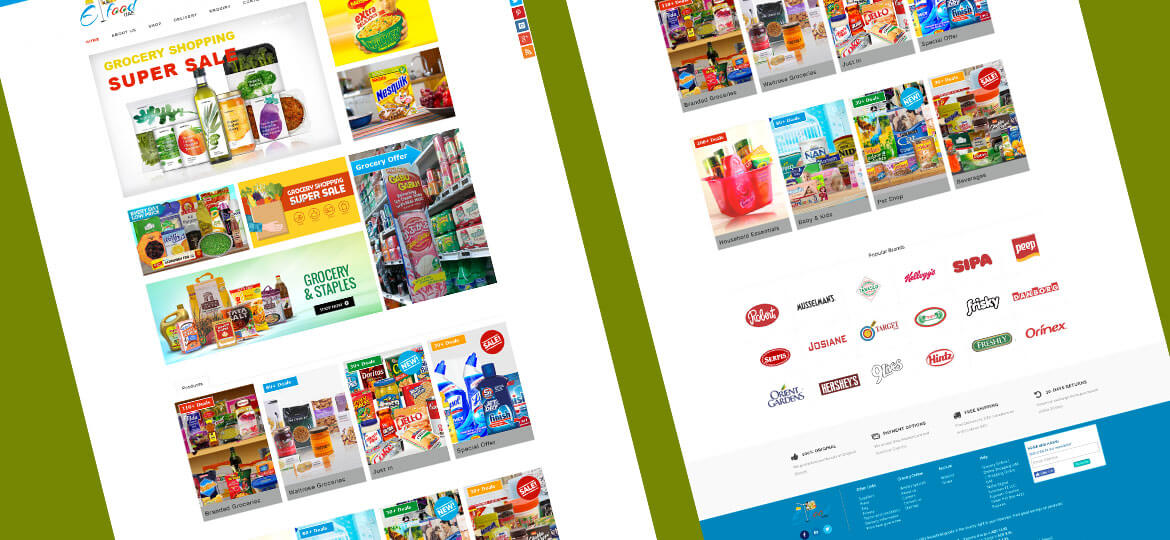
The ordering interface was designed around the principle that every additional click between “I am hungry” and “order placed” costs conversions. The homepage presents a location-aware restaurant listing with prominent cuisine filters, estimated delivery times, and minimum order indicators. Restaurant cards feature high-quality food imagery, aggregate ratings, and delivery fee transparency — all visible without clicking through to a detail page.
The visual design language uses warm tones and appetising food photography conventions. Typography is optimised for scanning rather than reading: bold restaurant names, clear price displays, and high-contrast call-to-action buttons. The interface draws on established food delivery UX patterns that users already understand, reducing the learning curve to zero.
Restaurant Listing and Menu Management
On the backend, we built a restaurant management panel that allows each restaurant partner to maintain their own menu, pricing, availability, and operating hours. The menu editor supports hierarchical categories, item modifiers and add-ons with individual pricing, combo meal builders, and the ability to mark items as temporarily unavailable without removing them from the listing.
On the customer-facing side, menus render as clean, scannable lists with category navigation, item images where available, clear pricing for base items and modifiers, and an “add to cart” interaction that provides immediate visual feedback. The cart persists across page navigation and updates in real time as items are added or removed.
User Account and Order Tracking
The user account system supports registration via email or phone number, saved delivery addresses with map-based pin placement, order history with one-tap reorder functionality, and saved payment methods for returning customers. Order tracking provides real-time status updates from order confirmation through preparation, dispatch, and delivery, with estimated time remaining at each stage.
Guest checkout was also implemented for first-time users who prefer not to create an account — requiring only a delivery address and phone number to complete an order. This removes a significant barrier to conversion for new users.
Payment Integration with UAE Gateways
We integrated with UAE-based payment processors that support local debit cards, Visa, Mastercard, and Apple Pay. The checkout flow presents payment options in order of local preference, with cash-on-delivery prominently available. Card payments are processed through a tokenised system that allows returning users to pay with a saved card in a single tap, while maintaining PCI DSS compliance by ensuring no card data touches the application servers.
Mobile-Responsive Ordering Experience
Given that the majority of food orders originate from mobile devices, the entire platform was built mobile-first. The mobile experience includes touch-optimised menu browsing with swipe gestures, a bottom-anchored cart summary that is always visible during menu browsing, a streamlined checkout flow that minimises form fields and maximises autofill compatibility, and an order tracking interface designed for one-handed phone use.
Technology Stack
- Frontend: Responsive web application built with modern JavaScript, optimised for sub-two-second load times
- Backend: PHP-based application server with RESTful API architecture
- Database: MySQL with optimised queries for real-time menu and order data retrieval
- Payment Gateway: UAE-based payment processor integration with tokenised card storage and PCI DSS compliance
- Image Delivery: CDN-served restaurant and food images with automatic WebP conversion and responsive sizing
- Caching: Multi-layer caching strategy — page cache for static content, object cache for menu data, browser cache for assets
- Maps: Google Maps API for delivery address selection and restaurant location display
- Notifications: Email and SMS notifications for order confirmations, status updates, and delivery completion
- Analytics: Custom event tracking for funnel analysis — restaurant views, menu interactions, cart additions, checkout initiation, and order completion
- Security: SSL encryption, input sanitisation, rate limiting on API endpoints, secure session management
Results Delivered
The platform launched with strong performance metrics and demonstrated consistent improvement as the restaurant network expanded.
Page Load Performance
The restaurant listing page loads in under 1.8 seconds on standard mobile connections. Individual menu pages render in under 1.5 seconds, with images loading progressively to avoid blocking the initial content display. These load times are competitive with native mobile applications and significantly outperform many web-based food ordering experiences.
Order Completion Rate
The checkout flow achieved a 72% completion rate from cart to confirmed order — well above the industry average of 55-60% for food delivery platforms. The simplified checkout, guest ordering option, and prominent cash-on-delivery placement all contributed to minimising drop-off at the payment stage.
User Engagement
Average session duration reached 4.2 minutes, with users viewing an average of 3.8 restaurant menus per session. The reorder feature drove a 34% repeat order rate within the first month of each user’s registration, indicating strong product-market fit and a satisfying user experience.
Mobile Conversion
Mobile devices accounted for 78% of all orders placed through the platform. The mobile conversion rate matched desktop within a 5% margin — a result that validated the mobile-first design approach and confirmed that the responsive implementation was not compromising the ordering experience on smaller screens.
Platform Reliability
The platform maintained 99.8% uptime during peak ordering windows (12:00-14:00 and 19:00-22:00), with zero order-processing failures during the first quarter of operation. Database query optimisation and caching strategies ensured consistent response times even as the restaurant network and concurrent user base grew.
Key Takeaway
Building a food delivery platform that competes with established players requires relentless focus on speed and simplicity at every touchpoint. By treating every millisecond of load time and every unnecessary form field as a direct threat to conversion, we delivered a platform that performs at the level users expect from native applications — entirely through the web browser.
Planning a food tech or marketplace platform in the UAE? Talk to our development team about building a custom solution.